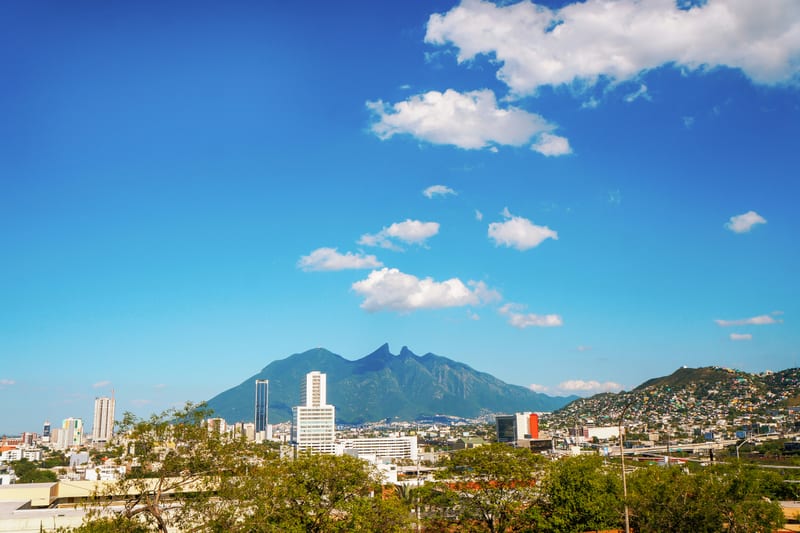
January
22 / 10 °C, four rainy daysSMN (Conagua), climate normals 1991-2020, Monterrey (Obs) station.. Sunny, a cold front every few days, record low -7 °C. Dust season begins.
Monterrey runs from a 36 °C average high in August to a 10 °C average low in January, with a third of the year's rain falling in September and 50 to 56 cold fronts between September and May. The chart below carries the official SMN normals month by month; the rest covers the heat, the floods, the fronts, and the two arrival dates exchange students face.
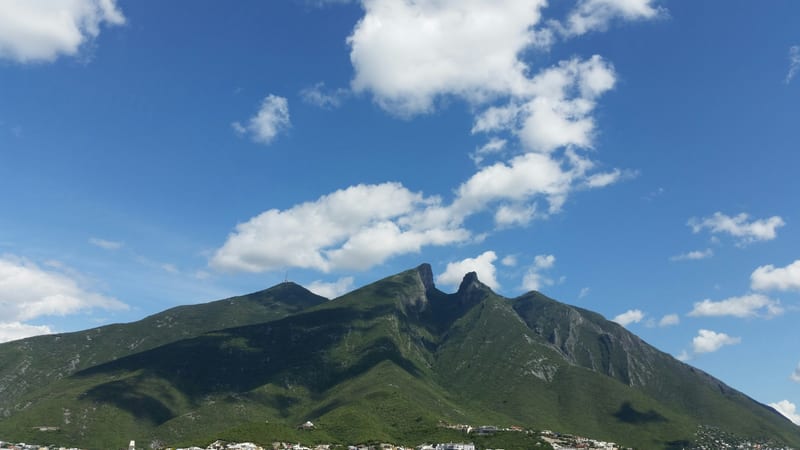
Monterrey has a hot semi-arid climate (Köppen BSh) at about 540 m, on the dry side of the Sierra Madre OrientalWikipedia ES, Monterrey, clima; SMN.. Average afternoons run from 22 °C in December to 36 °C in August, and the 667 mm of yearly rain fall mostly between May and OctoberSMN (Conagua), climate normals 1991-2020, Monterrey (Obs) station..
22°72°
10°50°
22
Jan
Cold fronts
24°75°
12°54°
27
Feb
Cold fronts
28°82°
15°59°
29
Mar
Best weeks
31°88°
18°65°
34
Apr
34°92°
21°70°
53
May
36°96°
23°74°
63
Jun
Hottest
36°96°
23°74°
60
Jul
Hottest
36°97°
24°74°
73
Aug
Hottest
33°91°
22°71°
200
Sep
Wettest
29°84°
19°65°
64
Oct
Best weeks
25°76°
14°57°
30
Nov
Best weeks
22°71°
11°51°
23
Dec
Cold fronts
SMN (Conagua), Mexico's national weather service, climate normals 1991-2020, Monterrey (Obs) station.
Read it as four seasons. December to February: dry, sunny, fresh, a cold front every few days. March to May: the ramp, 28 °C in March, 34 °C in May, first storms and first heat waves. June to August: the furnace. September to November: wet at first, then the finest weeks of the year.
22 / 10 °C, four rainy daysSMN (Conagua), climate normals 1991-2020, Monterrey (Obs) station.. Sunny, a cold front every few days, record low -7 °C. Dust season begins.
24 / 12 °CSMN (Conagua), climate normals 1991-2020, Monterrey (Obs) station.. Spring semester starts. The day before a front is often 30 °C, then it drops 15 degrees in hoursABC Noticias, why it gets hot before a cold front, 2025-10-26..
28 / 15 °CSMN (Conagua), climate normals 1991-2020, Monterrey (Obs) station.. Best hiking month, last one before the heat. Texas dust days (five stations in the red on 19-20 March 2025Milenio, air quality and Texas dust, 2025-03-20.) and the start of wildfire season.
31 / 18 °CSMN (Conagua), climate normals 1991-2020, Monterrey (Obs) station.. Summer in practice. First spring storms, sometimes with hail (south of the city, 15 April 2026ABC Noticias, 2026-04-15.). Nights still pleasant.
34 / 21 °C, first real rains, 53 mmSMN (Conagua), climate normals 1991-2020, Monterrey (Obs) station.. First heat waves: 13-17 May 2025 ran 40 to 44 °CTelediario, ola de calor mayo 2025.. The CFE summer electricity tariff is on.
36 / 23 °CSMN (Conagua), climate normals 1991-2020, Monterrey (Obs) station.. The observatory of Conagua, the national water agency, logged 44.8 °C on 21 June 2023Conagua via Milenio, 2023-06-21.. Hurricane season opens on the 1st.
36 / 23 °CSMN (Conagua), climate normals 1991-2020, Monterrey (Obs) station.. The canícula, the driest and hottest forty days, starts around 15 JulyABC Noticias, canícula 2026, 2026-07-15.. Alex (2010) and Hanna (2020) were July storms.
Hottest month: 36 / 24 °C, 259 hours of sunSMN (Conagua), climate normals 1991-2020, Monterrey (Obs) station., about 20 muggy daysWeather Spark, Monterrey, 1980-2016 data.. Fall-semester students land on the 1st. The 2026 peak was 40 °C on the 22ndMVS Noticias, 2026-08-20..
33 / 22 °C and 200 mm, nine rainy daysSMN (Conagua), climate normals 1991-2020, Monterrey (Obs) station.. Peak hurricane season. First cold front around the 20th (22-23 September in 2026ABC Noticias, 2026-09-20.).
29 / 19 °C, still 64 mmSMN (Conagua), climate normals 1991-2020, Monterrey (Obs) station.. Storms can still be nasty (three deaths on 16-17 October 2024La Silla Rota, 2024-10-17.). From mid-month, the best weeks of the year.
25 / 14 °C, 30 mmSMN (Conagua), climate normals 1991-2020, Monterrey (Obs) station., clear skies. The month to pick if you can pick one. Summer tariff over, heaters in the shops.
22 / 11 °C, driest month, 22 mmSMN (Conagua), climate normals 1991-2020, Monterrey (Obs) station.. Sunset 17:56 on the 21stsunrise-sunset.org, Monterrey, 21 December 2026.. Snow on 8 December 2017 and 24 December 2004ABC Noticias, snow in Monterrey, 2025-01-21.. Fall semester ends around the 3rd.
Late October to November wins: 25 to 29 °C afternoons, dry, clear, the trails open. March is the runner-up, 28 °C and the last cool nights, and the right season for the desert weekend trips. April is already 31 °C on an average afternoon; June to August is for people who have to be here. December to February works if you accept the fronts.
Exchange students do not pick, the calendar does: Tec's fall semester lands you on 1 August (classes 9 August to 3 December) and the spring one on 31 January (classes 8 February to 11 June)Tec de Monterrey, Study in Mexico calendar 2027.. UDEM and UANL run on similar weeks. What each first week looks like:
Furnace
Front season
Averages from the SMN 1991-2020 normals for the arrival weeks; the rest is what the first week looks like in practice.
The room matters more than the suitcase. A minisplit in the bedroom and a landlord who answers the electricity question (next section) make August survivable; a blanket and a plug-in heater fix February. The rooms near Tec, UDEM and in San Pedro list what each one has, the guide to living in Monterrey covers the rest of the arrival, and the other Monterrey guides take it from there.
What to pack, whatever the month
The hot season lasts 4.3 months, 2 May to 11 September, with daily highs above 32 °CWeather Spark, Monterrey, 1980-2016 data.. The Conagua observatory has recorded 44.8 °C on 21 June 2023Conagua via Milenio, 2023-06-21.. The canícula, the forty driest and hottest days, starts around 15 JulyABC Noticias, canícula 2026, 2026-07-15.. Locals call the whole thing the calorón.
It is dangerous, not just unpleasant: Nuevo León counted 438 heat cases and 14 deaths in 2024Secretaría de Salud federal via Milenio, 2025-10., the UV index reaches 11+ between 13:00 and 14:00MVS Noticias, 2025-07-21., and in June 2023 the state cut school days to two hours and closed the school year a month earlyABC Noticias 2023-06-13; Excélsior, June 2023..
Living with it: walk before 10:00 or after 19:00 (the twenty-minute walk to campus is a July swim), move the workout to the air-conditioned studios around Tec de Monterrey and San Pedro, spend afternoons in the museums, and for real air go up: the Chipinque summit stands at 2,229 m, 1,700 m above the cityWikipedia, Cerro de Chipinque., twenty minutes from San Pedro (the free things to do guide has the way in). Budget the summer electricity line with the student budget guide.
667 mm a year on 63 rainy days, and September alone brings 200 mmSMN (Conagua), climate normals 1991-2020, Monterrey (Obs) station.. The rest spreads thinly from May to October; December to March is nearly dry. Rain comes as a chubasco, a short violent downpour that dumps a month of water in an hour, not as a grey week.
The big floods are hurricane remnants from the Gulf. Alex, 1-2 July 2010: up to 700 mm in 60 hours, the Santa Catarina river at 2,500 m³/s, 15 deaths in the stateWikipedia ES, Huracán Alex (2010); Milenio, 2024.. Hanna, 26 July 2020: 550 to 600 mm in parts of the metroEl Horizonte, July 2020.. Alberto, 19-20 June 2024: emergency declared in all 51 municipalitiesForbes México; ABC Noticias, June 2024.. Even a plain cold front can kill: three people in the rains of 16-17 October 2024La Silla Rota, 2024-10-17..
The upside is the water the storms leave: in 2022 the dams fell below 5 % and the city lived on six hours of running water a dayEl Universal, día cero en Monterrey, 2022.; in September 2026 they sit around 80 %MVS Noticias, dam levels, 2026-09-23.. Spring adds hail, as on 26 May 2025 north of the cityEl Mañana, 2025-05-27.. Two sources worth following:
Rain reports by municipality, road closures, hail, cold-front timing. Faster than the news sites that quote it.
Conagua's forecast page: cold-front bulletins, hurricane warnings, heat-wave notices, and the normals used on this page.
Winter is a sequence of frentes fríos, cold fronts, not steady cold. They run from September to May: about 50 in 2025-2026 and 56 forecast for 2026-2027Conagua / SMN via El Informador, 2026-09-18; ABC Noticias, 2026-05-07.. Each arrives with the norte, a dry north wind gusting 40 to 70 km/hABC Noticias, frente frío 11, 2025-10-27.. The day before is often the hottest of the week, 30 °C, then the thermometer falls to 12 °C or lower in a few hoursABC Noticias, why it gets hot before a cold front, 2025-10-26..
Between fronts, January is 22 °C in the afternoon and 10 °C at dawnSMN (Conagua), climate normals 1991-2020.. The extremes are real: record low -7.5 °C, and the February 2021 winter storm took the metro to about -5 °C, cut the power and killed four peopleInfobae, tormenta invernal en Nuevo León, 2021-02-15.; UDEM, the Universidad de Monterrey, cancelled the day. The surprise is indoors: houses are tiled, open-plan and unheated, so a 10 °C morning feels colder in the bedroom than on the streetExpat Exchange, what to pack when moving to Monterrey.; an electric heater from around MXN$629Telediario, calefactores baratos en Monterrey. fixes it. Front season is also dust season: from January to March the norte carries Texas soil into the valley, and the air-quality guide says what to do on those grey mornings.
Once every few years. Snow fell on 8 December 2017 and 24 December 2004; sleet on 14 February 2021 and in January 2025 on the higher zones. The big one, 9 January 1967, left 30 to 60 cm. No snow boots needed.
Semi-arid on paper (667 mm a year, 63 rainy days), but Gulf air makes summer sticky: August has about 20 muggy days, what locals call bochorno. December to March is genuinely dry.
No. Mexico dropped daylight-saving time in 2022; only the border town of Anáhuac still changes. Sunset is at 17:56 on 21 December and 19:36 on 21 June.
Go indoors: the museums around the Macroplaza, the central square, are a ten-minute walk from each other, and the San Pedro malls were built for this weather. A September storm passes in a couple of hours; a tropical storm can sit on the city for two days. Stay off the underpasses either way.
Not as wind, the city is 200 km inland. What arrives is the rain: Alex (July 2010, 15 deaths in the state), Hanna (July 2020) and Alberto (June 2024) all flooded the same streets. Season: 1 June to 30 November. One or two a decade reach the city.
Check the listing for a minisplit (wall air-conditioning unit): it is what makes June to September livable. Heating is almost never installed; houses are tiled and open-plan, and December mornings feel colder indoors than out. A plug-in heater from around MXN$629 fixes that.