Getting started
Getting around Monterrey without a car: metro, buses, apps
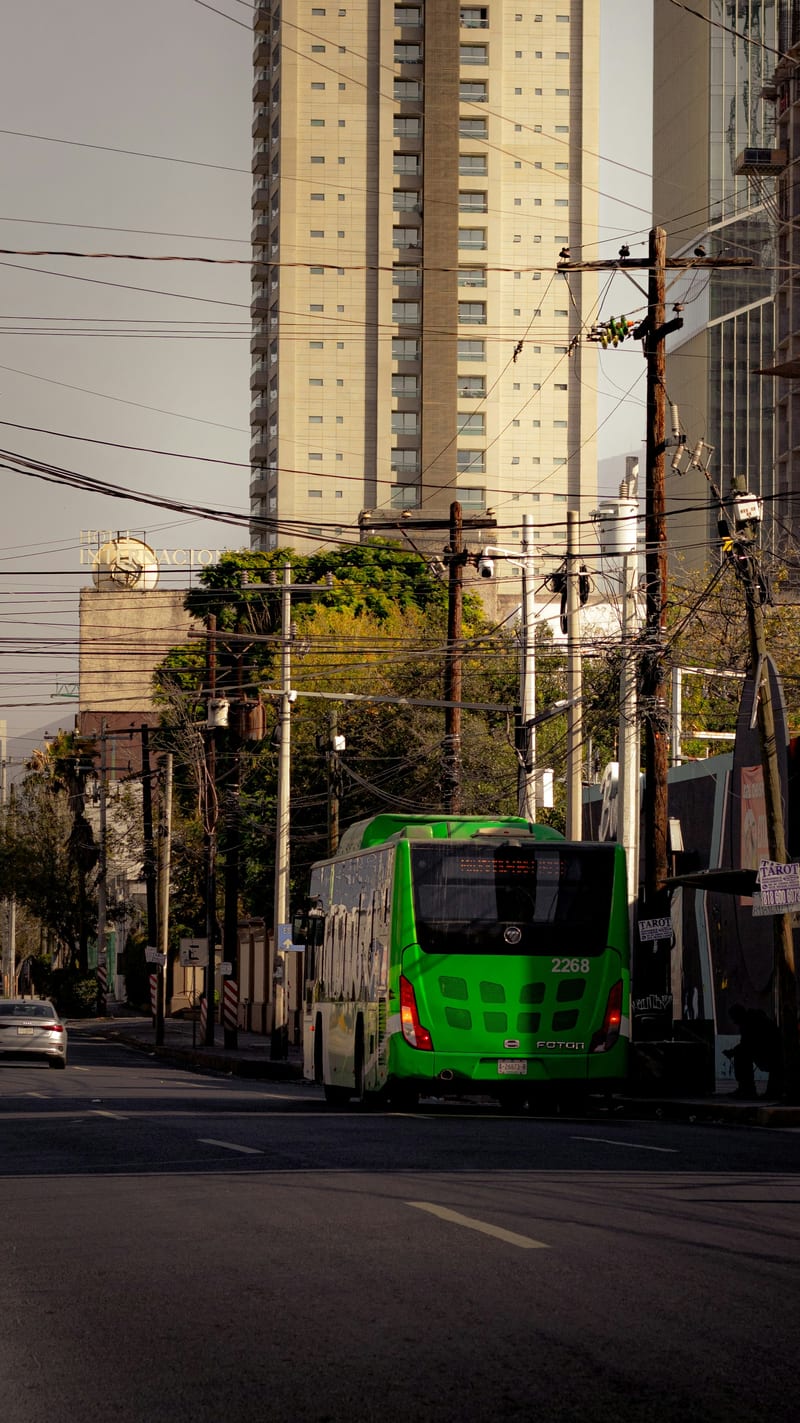
Monterrey is one of three Mexican cities hosting the 2026 World Cup in June, and most of its 5 million residents move around without a car. The system runs on three Metro lines, the cashless Me Muevo card for the city buses, and Uber and DiDi for everything else. The five sections below cover the metro, the buses, the apps, the airport, and reaching Estadio Monterrey on match day.
🚇 How the Monterrey metro works: lines and stations
The system, operated by Metrorrey, has three operating lines. Each one carries a distinct flow of riders, and as a tourist you will almost certainly only need one of them.
Línea 1 (yellow): east-west spine
The one most visitors use. Serves the Centro stations, passes Parque Fundidora (FIFA Fan Festival, 40,000 capacity) and reaches Exposición, the closest stop to the World Cup stadium.
Línea 2 (green): north to south through downtown
Crosses central Monterrey vertically. Useful to switch between Centro neighborhoods and the northern colonias around the airport feeder routes.
Línea 3 (red): Centro to the northeast
Connects the historic core to the northeastern districts. Lowest tourist traffic of the three lines.
The often-promised Lines 4 and 6 will not actually carry passengers during the World Cup. The state confirmed in April 2026 that only 11 km of the new lines (about 30 % of total) will open, and only for demonstration runs between Citadel in San Nicolás and Parque Fundidora. Full passenger service is now projected for September-October 2027.
Line 5, originally planned to head south to Mederos, was postponed indefinitely in November 2024 after pushback from residents along the route. The state is putting in restructured bus routes (called Cuenca Sur) instead.
Service runs Monday to Saturday, 4:45 to 24:00, with Sundays reduced. Trains run every 3 to 5 minutes on Línea 1 at peak, stretching to 10 minutes on quieter evenings.
🚌 City buses and the Me Muevo card
The bus network, the camiones, covers most of San Pedro (where the metro doesn't reach), the southern colonias and the connector loops between Centro and the universities. The same Me Muevo card works on every official bus, with one big caveat.
Metro
MXN$10.20*
* Effective price in May 2026.
Camión
MXN$16.70*
* Effective price in May 2026.
You won't find a polished local trip-planning app. Google Maps gets you about 80 % of the way: correct route number, correct stop, sensible time estimate. The remaining 20 % comes down to asking the driver in basic Spanish; a "¿pasa por Macroplaza?" covers most of it. For trips into the south, the new Cuenca Sur restructured routes (the replacement for the postponed Line 5) now run 25 electric premetro units financed by MXN$250 million in private investment.
🚖 When Uber and DiDi beat the metro
Both Uber and DiDi operate fully in Monterrey. DiDi is consistently the cheaper of the two, often by 10 to 30 % on identical routes (one comparison from Escobedo to the airport: MXN$325 on DiDi vs MXN$460 on Uber). Local yellow taxis exist but rarely use a meter. If you take one, fix the fare before getting in.
The app earns its place in a handful of situations. For a daytime errand inside one zone, metro plus a 10-minute walk almost always wins on price.
After 22:00
Metro is closed, and the safety calculus shifts away from late-night station-to-door walks.
To or from the airport with luggage
Saves you the metro change at Y Griega. Pickup zone signposted at MTY arrivals.
Between zones not on Línea 1
San Pedro to Centro is the classic case. The metro detour costs you 25 minutes.
Any colonia the metro doesn't reach
Large parts of San Pedro, Cumbres, Linda Vista and the southern districts have no metro coverage.
✈️ Getting from the airport to the city
Monterrey International (MTY) is in Apodaca, about 30 km northeast of downtown. There is no metro link; Línea 4 will eventually serve the airport but won't carry passengers before late 2027. Four practical ways to do the trip today, in roughly ascending cost order:
-
1
Bus Ruta 109 Aeropuerto - Y Griega (MXN$16.70)
Drops at the Y Griega metro station, where you change to Línea 2 for the Centro. 40 new buses in 2026 dropped average wait from 25 to about 10 minutes. With luggage, total trip runs 1 h to 1 h 15.
-
2
Punto a Punto shuttle (MXN$350 per person)
Three fixed routes, including direct service to Centro and to San Pedro. Slower than an Uber, faster than the bus + metro combination.
-
3
Authorized taxi at the arrivals counter
Fixed by zone, not negotiated: MXN$290 to Centro, MXN$320 to San Pedro. You pay at the counter and hand the chit to the driver. Safest curbside pickup of the four.
-
4
Uber or DiDi
Roughly MXN$280-380 to Centro, MXN$200-280 to San Pedro. Counter-intuitively, Uber/DiDi to San Pedro is often cheaper than the fixed counter taxi to the same zone. 35 to 50 minutes from gate to door.
Pickup at MTY is well signposted on the way out of arrivals. The fixed-tariff counter taxis are the safest choice if you have any doubt; for San Pedro specifically, the app option usually beats them on price.
🚍 Leaving the city: the Central de Autobuses
The metro and the camiones cover the city; for trips out of it you head to the Central de Autobuses de Monterrey, the intercity coach terminal on Av. Cristóbal Colón in the Centro. It sits right in front of metro Estación Central on Línea 1, so getting there is a single yellow-line ride with no transfer.
This is where you catch an ómnibus (intercity coach) to the rest of the country. Saltillo is about an hour away, and there is direct service to Mexico City, Guadalajara, Chihuahua and beyond. The main lines under one roof are Grupo Senda (the regional workhorse, cheapest for Saltillo and the north), ETN and Turistar (premium, wide reclining seats), plus Omnibus de México, Transportes del Norte and Estrella Blanca. Buy at the counter, or on each line's app for the busy routes.
🏟️ How to reach the World Cup stadium
Estadio BBVA, officially renamed Estadio Monterrey for the tournament under FIFA naming rules, sits in Guadalupe, east of downtown. Capacity is set at 53,500 for the World Cup. Av. Pablo Livas is the main artery and gets dedicated lanes for official transport plus pedestrian corridors on match days.
The stadium hosts four matches between 14 and 29 June 2026: three group-stage games on 14, 20 and 24 June, and one Round-of-32 game (dieciseisavos de final, the new round introduced by FIFA's 48-team format) on 29 June at 19:00 local time, Group F winner vs. Group C runner-up.
Three ways to reach the stadium
🚇 Metro: the cheapest option by far
Línea 1 east to Exposición, then 10 to 15 minutes on foot via Av. Pablo Livas. One MXN$10.20 tap on your Me Muevo card. The avenue itself becomes the official walking corridor on match days, with security checkpoints staggered along it.
🚍 Park & Rail shuttle: for fans driving in
Temporary parking lots across Monterrey, connected to the stadium by official FIFA shuttles. The round-trip stays under MXN$100 per person, the local benchmark. Match-day cordons close every street within several blocks of the stadium to non-credentialed cars, so this is the only viable route for visitors arriving by car from outside the city.
📱 Uber or DiDi: when you accept the surge
Set drop-off to one of the official designated zones (no kerbside stops near the cordon). Surge pricing is brutal in the two hours before kickoff and in the 30 minutes after the final whistle. Walk 10 minutes away from the cordoned area before opening the app and the surge drops meaningfully.
The city's official strategy is Park & Rail: temporary parking lots across Monterrey, connected to the stadium by official FIFA shuttle buses. Combine that with the metro and you stay under the MXN$100-per-person round-trip ceiling local officials have publicly framed as the affordable benchmark.
If you'd rather settle in for the tournament than commute from a hotel, our living in Monterrey guide covers neighborhoods and the small things nobody mentions. For after-match plans, the nightlife guide maps where Centro and San Pedro pour their drinks. The full guides index has the rest.
Common questions
⏰ How early should I leave for the Estadio Monterrey Round of 32 match?
The Round of 32 game (Group F winner vs. Group C runner-up) kicks off on 29 June 2026 at 19:00 local time. Stadium gates open three hours before kickoff. Plan to be at the security perimeter at least two hours before to absorb the FIFA bag check, QR ticket scan and facial-recognition lane.
Metro from the Centro: Línea 1 (yellow) east to Exposición, then follow Av. Pablo Livas east on foot for 10 to 15 minutes. The avenue itself becomes the official walking corridor on match days.
Park & Rail: drive to one of the temporary city parking lots, FIFA shuttle from there. The combination is capped under MXN$100 per person round-trip, the local benchmark.
Uber / DiDi: drop-off at official zones only. Walk 10 minutes from the cordoned area before opening the app to dodge the worst surge, both before kickoff and in the 30 minutes after the final whistle.
💳 Where do I buy the Me Muevo card, and what does it cost?
The card itself is MXN$20 (about €1), plus whatever you load on top of it. Buy it at any Metro station ticket window or at one of the 1,485 OXXO convenience stores in Nuevo León authorized to sell and top up. Recharge works the same places, plus the URBANI app on your phone. If you only need a couple of rides, skip the plastic and pay through URBANI directly: the app generates a QR code valid for 15 minutes that you scan at any turnstile.
🕐 What time does the Monterrey metro open and close?
The metro runs from around 5:00 to midnight Monday to Saturday, with reduced hours on Sunday. The last train leaves the terminals around 23:30, so do not cut it fine. Trains come every 3 to 5 minutes at peak on Línea 1, stretching to about 10 on quiet evenings. After midnight there is no service, so plan an Uber or DiDi for the trip home.
🌙 What about getting around at night?
From around 22:00, the answer is almost always Uber or DiDi, not the metro or buses. Two reasons.
First, the metro shuts at midnight (4:45 to 24:00 Monday to Saturday, reduced Sunday); if you are out late, you will need a ride home anyway. Second, the walk from your station to your front door is the real risk variable. National-level data on Mexico (ENVIPE) puts about a third of reported sexual-harassment incidents on public transport; women travelling solo at night in Monterrey routinely report avoiding empty buses and dim back streets. Uber and DiDi both have an in-app "share trip" feature that streams your location to a contact in real time, worth using. DiDi is consistently 10 to 20 % cheaper than Uber on identical routes, and after 22:00, before the 2 a.m. nightlife rush, both apps are at their cheapest of the day.
🚴 Can I walk or bike around Monterrey?
Walking works inside one colonia (San Pedro residential blocks, around Tec campus, central Barrio Antiguo during the day) but not between zones. Distances are American-scaled and the metro+app combo always beats it for anything past 20 minutes. Summer is brutal: average highs hit 35 °C from May, 38 to 40 °C in July and August. June World Cup days will be hot, so plan transit so you are not exposed for more than 15 minutes on foot.
Public bike share does not really exist in Monterrey (unlike CDMX or Guadalajara). The closest thing is BiciTec on the Tec de Monterrey campus, which is closed to non-students. Some bike lanes run along Calzada del Valle in San Pedro, but cycling is not the realistic option for most visitors.
Read more

Ready to find a room in Monterrey?
Join the student waitlist. When matching rooms come up, you hear about them first.